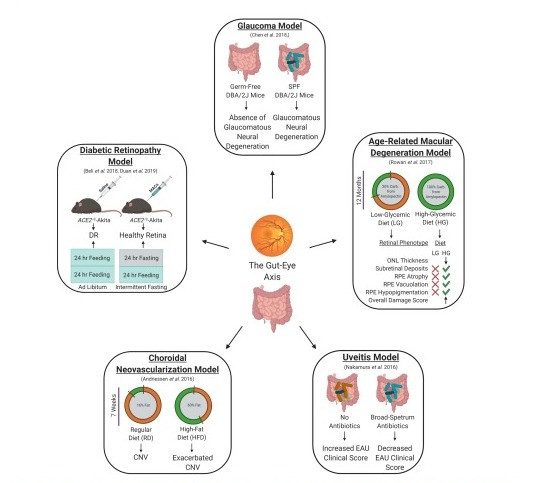
The Gut-Eye Axis: Lessons Learned from Murine Models
R$ 0,00

The irreversible loss of retinal cells is one of the leading causes of blindness worldwide. Diseases such as age-related macular degeneration (AMD), retinitis pigmentosa and Stargardt disease cause progressive degeneration of the retinal pigment epithelium (RPE) and photoreceptors, structures essential for vision. Although important advances have been made with gene therapies and drugs, there are still few alternatives capable of restoring retinal tissue once cell loss is established.
In this scenario, pluripotent stem cells (PSCs) emerge as one of the most promising approaches in regenerative medicine. Capable of differentiating into virtually any cell type in the body, they offer the possibility of generating new retinal pigment epithelium cells and new photoreceptors to replace those destroyed by disease, with the potential to restore part of visual function.
The retina is considered one of the best models for applying this technology. Besides being a tissue with easy surgical access, it allows precise monitoring of grafts through high-resolution examinations, such as optical coherence tomography (OCT), autofluorescence and other imaging techniques that make it possible to monitor the survival and integration of transplanted cells.
In recent decades, preclinical studies and phase I and II clinical trials have shown that transplantation of cells derived from pluripotent stem cells is technically feasible and has an encouraging safety profile, especially for replacing the retinal pigment epithelium in patients with AMD and Stargardt disease. At the same time, new strategies involving induced pluripotent stem cells (iPSCs), gene editing, retinal organoids and biomaterials have been broadening the prospects for increasingly efficient and personalized retinal regeneration.
More than a therapeutic alternative, cell therapy represents a paradigm shift in ophthalmology. Rather than merely slowing the progression of degenerative diseases, it seeks to replace lost cells, rebuild retinal tissue and restore visual function, bringing regenerative medicine closer to clinical practice and paving the way for treatments that, until a few years ago, were considered impossible.